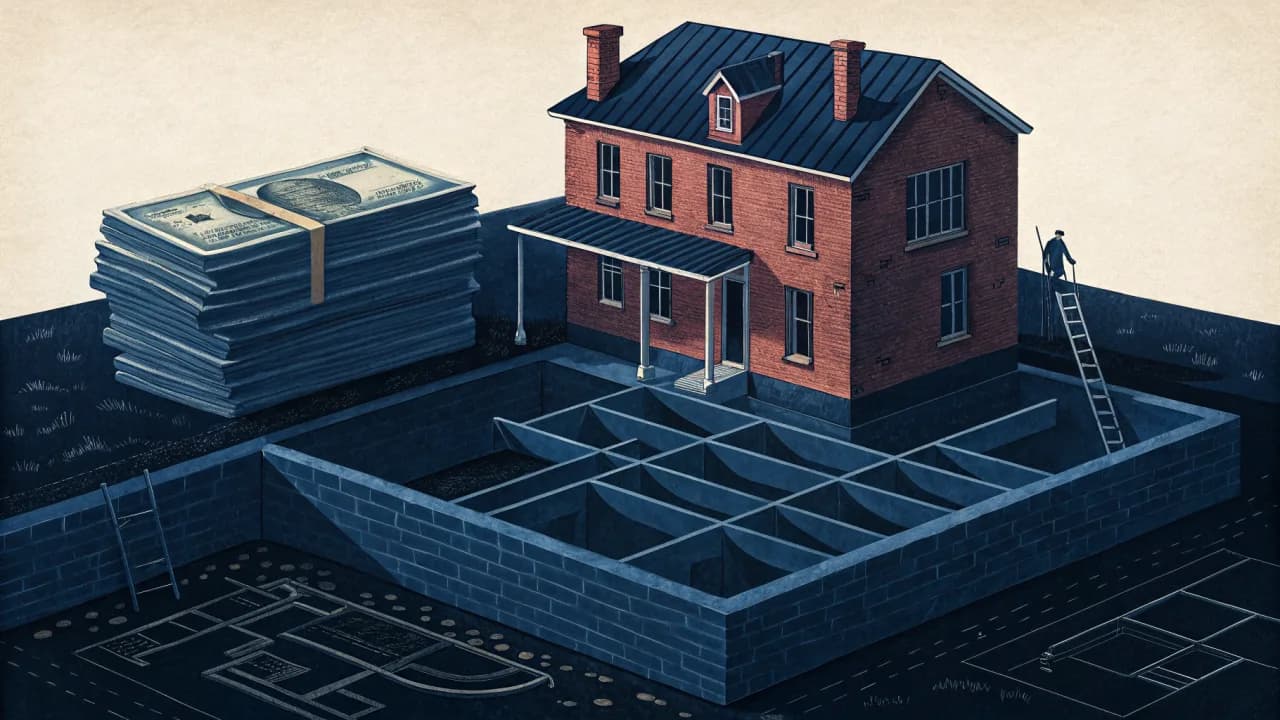
How to Create Affordable Quality Housing in DC, and Make Money Work
We explain the real mechanism behind affordable housing development in DC: how mixed-income projects, local subsidy tools, and operational discipline allow developers to earn market-rate returns while delivering income-restricted units.

What It Means to Create Affordable Quality Housing in DC and Make Money
We believe that creating affordable quality housing in DC and making money is not a contradiction. It requires patient capital, deep knowledge of local subsidy tools like the Housing Production Trust Fund and the DC Preservation Fund, and a vertically integrated operating model that controls costs across the full development lifecycle. By targeting workforce tenants at 80-120 % AMI and using cross-subsidy within mixed-income projects, developers can deliver income-restricted units without sacrificing market-rate returns.
This article is for experienced investors and developers who already know the basics. We are going to skip the definitions and get straight to the mechanism that actually makes the math work. Then we will show you our framework and the mistakes that still sink good projects.
The Mechanism: How Mixed-Income Development and Public-Private Finance Actually Work
The core idea is simple: in a high-cost market like DC, no single source of capital carries the full burden. Instead, developers layer multiple instruments so that each absorbs a piece of the risk. When done right, the result is a project that pencils out with rents affordable to households earning 60-80 % AMI while generating a market-rate return on the overall capital stack.
Here are the main levers that make the mechanism turn:
- Inclusionary upzoning. Jurisdictions like Arlington and Fairfax counties tie increased density (more units, taller buildings, reduced parking requirements) to a mandatory set-aside of affordable units. This model, described in Mallach et al.'s A Decent Home (2020) as inclusionary housing theory, effectively subsidizes affordable units via the additional market-rate units. DC policymakers are actively evaluating similar updates.
- DC's Housing Production Trust Fund (HPTF) and the DC Preservation Fund. HPTF provides low-cost loans and grants that shrink the developer's equity requirement. The DC Preservation Fund is a revolving loan fund that uses private dollars at a 3‑to‑1 match, financing acquisition and predevelopment for preservation projects.
- Cross-subsidy. Market-rate units in the same building generate cash flow that covers the deficit from income-restricted units. This is combined with Low‑Income Housing Tax Credits (LIHTC) and soft debt from the Amazon Housing Stability Fund or other corporate philanthropic sources to lower the weighted average cost of capital.
- Private capital efficiency via a vertically integrated platform. When your firm handles acquisitions, construction, leasing, and asset management in-house, you capture margins that would otherwise go to third-party contractors. That margin can be reinvested into the project's rent subsidy gap.
The key is that each layer works only if the operator has the balance sheet and track record to access it. The Urban Institute has documented the persistent "doughnut hole" in financing for units serving households at 30-50 % AMI. The gap is real. It is also fillable, but not by chasing more grants. It is filled by operational efficiency and a capital structure that defers speculative returns.
When the Abstractions Leak: The Real Pain Points That Derail Affordable Housing Projects
Why do so many well-intentioned projects fail to deliver both quality and profit? Because the mechanism described above only works when every piece is executed with discipline. The common failure points are not glamorous.
First, developers overestimate on anticipated appreciation rather than stabilized operating income. They pencil in rent growth that never materializes, then raise rents on the income-restricted units to cover debt service, undermining the entire purpose of the project. That is not affordable housing, it is market-rate housing that briefly wore a costume.
Second, many operators stall in the scarcity‑subsidy cycle. They spend years chasing HPTF allocations, LIHTC rounds, and Amazon grants without committing to a site or a design. The project never breaks ground because the developer treats subsidies as the primary source of capital rather than a supplement. The DC Policy Center has described this dynamic as a systemic bottleneck that strangles production.
Third, compliance costs are routinely underestimated. Layering HPTF, LIHTC, and a corporate grant creates reporting requirements that require a full-time compliance officer. When that cost is not budgeted, it eats into operating reserves, and deferred maintenance follows.
Fourth, the gap at 30-50 % AMI is a real financing challenge. But it also reflects a gap in unit design. Many developers build for the very low income bracket (0-30 % AMI) because subsidy dollars per unit are higher there, but they ignore the workforce families who actually earn too much for deep subsidy and too little for market rent. Those households end up leaving the region.
Finally, poor asset management destroys the "quality" in affordable quality housing. A building that is not well managed, with slow maintenance, high turnover, weak leasing standards, loses its rent premium and drives up operating costs. Profitability at lower rents depends on stable, long-term tenancy, which only comes from on-site property management that treats residents as customers.
A Proven Framework: How to Execute an Affordable Quality Housing Project in the DC Region
The steps below are sequential. Each builds on the previous. Skip one and the whole project tilts.
Identify a site near transit in a high-barrier-to-entry neighborhood with strong schools and job access. Do not chase the cheapest land. Pay for location that will sustain demand even in a downturn. DC's metro-accessible corridors, Columbia Heights, Petworth, Brookland, Navy Yard, are prime for workforce housing.
Secure the low-cost capital stack early. Apply to HPTF for a predevelopment loan, and approach the DC Preservation Fund for acquisition financing if preserving existing affordable units. The Amazon Housing Stability Fund may also reduce your debt costs if your project serves 50-80 % AMI. Tax-exempt bonds and LIHTC equity round out the stack. Do not sign a land contract until you have soft commitments.
Entitle through inclusionary zoning or a planned unit development (PUD). DC's zoning code allows density bonuses for affordable units. Use a PUD to negotiate extra height or floor area ratio in exchange for additional income-restricted units. The Arlington and Fairfax county model of inclusionary upzoning shows that this trade-off works at scale.
Design for operating efficiency. Insist on low-energy systems, durable finishes, and a unit mix that spans 30-120 % AMI. That range lets you capture both deep subsidy (below 60 %) and workforce (80-120 %) tenants. Avoid overbuilding amenities that raise common-area maintenance costs.
Construct with cost controls. A vertically integrated construction arm can reduce hard costs by 10-15 % compared to a general contractor mark‑up. If you do not have internal construction capability, negotiate a guaranteed maximum price contract with penalty clauses for overruns.
Lease to a balanced mix of market-rate and income-restricted tenants. Do not fill the building with only subsidized residents. The market-rate tenants provide the cash flow that subsidizes the lower rents. Use a lottery for the affordable units and waitlist for the market-rate ones.
Asset‑manage with a long‑term hold strategy. Avoid refinancing with a balloon payment that forces a sale in a peak-rate environment. Hold the asset for 10-15 years, refinance only when interest rates drop, and reinvest operating cash flow into capital improvements that keep the quality high.
We detail a similar approach in our article about how to invest in workforce housing projects in DC. The same principles apply whether you are a limited partner or a sponsor.
Common Technical Mistakes Developers Make in Affordable Housing and How to Avoid Them
What separates a project that closes from one that falls apart? Avoiding these six errors.
Focusing exclusively on very low-income tenants (0-30 % AMI). The subsidies are generous, but the operating costs per unit are higher and the rent coverage is thin. One vacancy can wipe out a year of net income. Balance deep affordability with workforce units.
Treating LIHTC or HPTF as "free money." They are not. The 15-year compliance period requires annual reporting, recertification, and inspections. Budget for a compliance specialist from day one.
Designing units that do not match local demand. In a school-rich corridor, three-bedroom units are worth a premium. In a downtown studio-heavy area, they are a liability. Know the submarket's demographics before you finalize the unit mix.
Structuring the capital stack with a balloon payment due in five years. Interest rates are volatile. If you cannot refinance at favorable terms, you may be forced to sell at the worst moment. Use long-term permanent debt (Fannie Mae, Freddie Mac, or HUD 221(d)(4)) that matches the 15-year compliance horizon.
Treating property management as an afterthought. The difference between 90 % occupancy and 95 % occupancy at lower rents is the difference between a solid return and a loss. Invest in on-site superintendents and a leasing team that treats affordable tenants with the same service as market-rate ones.
Overpaying for land by competing with luxury condo developers. Public land writedowns are available for affordable housing, negotiate with the District's Office of the Deputy Mayor for Planning and Economic Development. Do not pay market rate for land when the city wants you to build on it.
These mistakes are not hidden. They are the unglamorous operational failures that show up in every Urban Institute analysis of stalled projects. For more on evaluating execution capability, read our piece on how to evaluate real estate investment firms in DC.
Industry Benchmarks: What Urban Institute, ULI, and DC-Area Examples Tell Us About Viability
The evidence that affordable housing can be profitable is not theoretical. It is grounded in the work of institutions that study the region's housing market.
The Urban Institute has documented the "doughnut hole" that exists between 30-50 % AMI, a gap where conventional debt and subsidies do not align. Their research shows that closing that gap requires layering soft debt from sources like the DC Preservation Fund alongside philanthropic capital such as the Amazon Housing Stability Fund. Developers who use this structure consistently report stabilized returns in the 8-12 % range on a debt-heavy basis.
ULI publishes best practices for affordable housing production that emphasize cost reduction strategies, cross-subsidy, and the use of public land writedowns. Their work confirms that projects with a vertically integrated sponsor have lower default rates and higher resident satisfaction.
Arlington and Fairfax counties have used inclusionary upzoning for years to produce thousands of affordable units without direct public spending. By linking density bonuses to affordability requirements, usually 12-15 % of units set aside, they have created a market-driven pipeline. DC policymakers are looking at this model as a way to boost production without a new tax.
These benchmarks tell us one thing: the path exists. The viability depends on execution, not on policy whims.
How We Build Affordable Quality Housing at Felipe Ernst and Make It Work Financially
At Felipe Ernst, we operate as a vertically integrated platform covering acquisitions, development, construction, leasing, and asset management. That structure lets us capture the full value chain, which is the difference between making 8 % on a project and making 15 %.
Our thesis is focused on high-barrier-to-entry DC metro submarkets, particularly in the District and inner suburbs. We target workforce housing for households earning 80-120 % AMI, a segment where subsidies are lean but demand is enormous. Because we do not rely on speculative appreciation, we can hold assets for 15+ years, refinance only when rates drop, and reinvest cash flow into quality improvements.
We started with a single three-unit acquisition in Shaw, financed by a mortgage from my parents. That discipline, fund every deal with real equity, never overextend, has carried through to a portfolio of more than 2,000 units across the capital region.
We also teach this model at Georgetown University, where I serve as an adjunct professor in the School of Continuing Studies. The students who succeed are the ones who understand that the pro forma is not the deal. Execution is everything.
Our approach is not for every investor. It requires patience. It requires a team that can manage construction, property operations, and compliance simultaneously. But it is the only way we have found to deliver affordable quality housing in DC and make money in the process.
If you want to learn more about our investment approach, visit our about page or read our deep dive on why patient capital wins where speculators fall short.
Frequently Asked Questions About Creating Affordable Quality Housing in DC and Making Money
How do affordable housing owners make money?
They generate returns from three sources: fee income during development (construction management, asset management), stabilized operating cash flow from market-rate units, and long-term appreciation of the overall asset. The affordable units cover debt service and often generate operating surpluses if designed efficiently. Tax credits also provide dollar-for-dollar reduction in federal tax liability.
What income qualifies for affordable housing in DC?
Income limits vary by household size and are set as a percentage of the Area Median Income (AMI). For a one-person household, 30 % AMI is roughly $30,000, 60 % AMI about $60,000, and 80 % AMI around $80,000. Most DC affordable housing programs serve households earning 60 % or 80 % of AMI. The DHCD website publishes exact limits each year.
How to start an affordable housing project?
Begin by identifying a site near transit in a strong submarket. Then secure predevelopment financing through the DC Housing Production Trust Fund or the DC Preservation Fund. Submit a Planned Unit Development application to the Zoning Commission to negotiate density bonuses in exchange for affordable units. Secure LIHTC allocations and a construction loan. Design, build, lease, and hold for the long term. The framework above provides the full sequence.
How much money do you need to make to live comfortably in DC?
For a single adult without dependents, income around 100 % AMI (roughly $100,000) is generally considered comfortable, enough to cover rent, utilities, transportation, and savings. For a family of four, the number is closer to 180-200 % AMI. This is exactly why workforce housing at 80-120 % AMI is such a critical segment: the households earning these amounts are priced out of the market-rate stock but earn too much for deep subsidies.
Get new articles by email
New articles from Felipe Ernst, sent to your inbox.
By subscribing you agree to receive emails from Felipe Ernst about new articles. You can unsubscribe at any time.